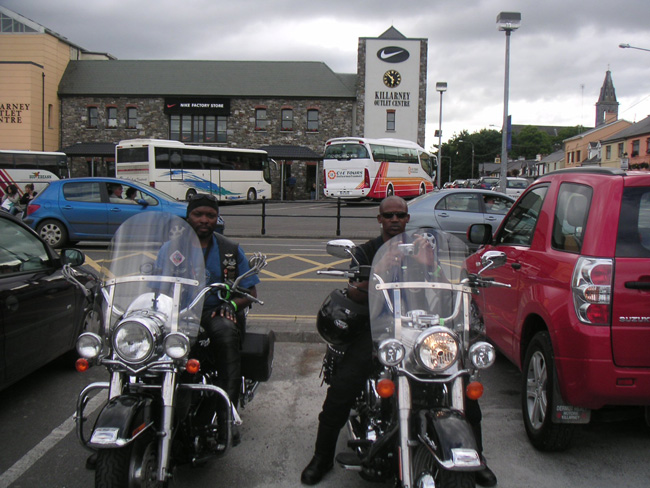
London to Killarney, Rep of Ireland
23-26 June 2006
Following the success of our last Charity Bike Ride in 2004 from London to Amsterdam in The Netherlands raising £3,000, we decided on a slightly different direction when planning this year’s fundraising ride.
Tola Obembe and myself were once again planning this year’s event. Essay Folami, who came along on the last ride, joined us again for this bike ride. He enjoyed the previous experience so much he ensured he wasn’t left out this time around.Ever since we decided on the destination, I started to notice how it rains virtually everyday in Ireland each time I watch the weather on the news. The first thing people who’ve been to Ireland say to me when I mention the Bike Ride is “I hope you’ve got your rain gear”. This initially got me concerned because it brought back memories of the storms we went through on our previous trip.
Tola arrived from Nigeria the day before the trip and we went to Black Bear Harley Davidson in Newmarket, Suffolk (about 55 miles from London) to pick up the bike he’ll be using for the trip. He used the opportunity of the ride back home as a dry run for the main event the next day.Friday 23rd June
Due to work commitments, Tola had to return to Nigeria the day we got back from our trip so we needed to fine tune our route because we realised we had no room for error on the return journey. Essay and I left Enfield at 6.45am to meet up with Tola at Feltham, an hour’s ride away. Tola was all packed and ready to go when we arrived and after saying our goodbyes to his family at 8.00am, we were soon on our way. I was riding solo while Essay was a passenger on Tola’s bike.
On our last fundraising trip to Amsterdam, we had relied solely on a printout of an AA Route from the internet only to get lost somewhere in Belgium without much hope of finding our way back on our route. Were it not for the help of some kind travellers we met who gave us directions to get us back on track, we’ll probably still be trying to make our way home. This time we were armed to the teeth with road maps, satellite navigation (or Sat Nav as it’s affectionally known) which unfortunately only covered the UK i.e. our route to the ferry port of Fishguard as well as printouts from the RAC route planner of four different routes. All we needed was good weather. The weather forecast was sunny spells and for once it lived up to expectation.
Feltham is right next to the M4 motorway which goes westbound all the way into Wales. Within 10 minutes we were on it cruising at 70mph with the Sat Nav doing what it does best. Our ferry crossing from Fishguard port to Rosslare in Ireland was scheduled for 2.30 and we had to be there at least half an hour before departure. With everything going smoothly we thought we should be able to complete the 4 and a half hour ride to the port in good time. Or so we thought.We hit road works about half and hour into the ride with speed restrictions of 40 mph. This went on intermittently for about 30 miles or so (meaning our estimated journey time had been increased significantly). Once we cleared the series of road works, we had to increase our pace in order to regain lost ground.
We were soon zooming past Bristol and about half an hour later the magnificent Severn Bridge loomed in front of us. I’ve seen it on TV and in pictures in the past but seeing it right in front of me was incredible with the Bristol Channel on the left and River Severn on the right.
This particular bridge is actually called the Second Severn Crossing. The first was built along the M48 to replace the ferry crossing from England to Wales and was opened by the Queen in 1966. However, it soon got congested with the increased traffic over the years. Work on the new Crossing over the M4 began in 1992, and was completed in 1996. It’s most certainly an impressive welcome monument into Wales. The scenery is equally impressive with a panoramic view of the Atlantic Ocean to our left.
At the end of the bridge is an array of tollgates, which to our delight, is free for motorbikes. Apart from being stuck behind a motorist who queued up in the “Cash Only” line wanting to pay by plastic, everything went pretty smoothly. We however needed to refuel, so we made our first stop since leaving London at the next available service station just a couple of miles or so up the road.
Being the middle of the biking season, we weren’t surprised to see other people on motorbikes but we certainly didn’t expect the large number of bikes lined up at the fuel station filling up. There were even some French riders who were in the middle of their tour of Europe and were also headed towards Fishguard.
After filling up, we had a quick drink and a cursory glance at the road map just to be doubly sure we were still headed in the right direction and, more importantly, to see if we were back on schedule after being slowed down by all the motorway road works we had encountered. We reckoned we were about halfway to Fishguard at that point but it had taken us three and half hours instead of the 2 hours we anticipated. There was no time to waste so we immediately set off again with more urgency.Severn to Fishguard
The first thing one notices as we rode through Wales is the road directional signs no longer made sense – that’s because they are in Welsh with brief English translations underneath. It takes getting used to because: on one hand it feels like we’re travelling through a foreign country, and on the other hand the scenery had a certain familiarity to it. Although Wales is part of the UK, it maintained it’s language, culture and now has its own devolved parliament. The language is widely spoken among its citizens to the extent that English is a second language to many Welsh people.
Riding through Wales was quite enjoyable, though we were getting rather tired at this point. The scenery was rapidly changing and became very much unlike what we had travelled through. It seemed mountains and hills surrounded us perpetually. The motorway more or less hugged the coastline so the beautiful countryside kept our minds off our sore bums. One thing you won’t fail to notice are the sheep. There were sheep in large numbers grazing virtually in every farm we went past. Though it was tempting to start counting sheep I had to avert my eyes so I could continue to enjoy the winding road and not nod off. By now the M4 motorway had morphed into the A48 with a 50mph speed limit, which slowed the pace a little bit.
We finally arrived at Fishguard at 1.30pm with seconds to spare for checking-in. There were already a few cars, caravans and other motorbikes on the queue to board ahead of us and loads more arrived after us. There was a delay in boarding which gave us an opportunity to stretch our weary legs and grab our first bite of the day at the sandwich bar next to the queue of vehicles.
The wait for boarding lasted around 20 minutes. The boarding was unlike on our last trip when we crossed the English Channel via Euro Tunnel. On that occasion, we simply rode straight onto the train compartments and stayed with our parked bikes for the duration of the crossing. However, this time we had to strap the bikes down in place to prevent toppling over (the bikes, not us) as the ferry rocked back and forth on its journey across the Irish Sea.
The ferry set sail at 3.00pm, half an hour behind schedule and after taking a quick familiarity tour of the vessel, we settled down for brunch in the restaurant. The 3 hour crossing itself was uneventful so I managed to nap for an hour which was quite refreshing seeing that I’ve been up since 4.30 am and had already done 5 hrs on the bike.Rosslare to Killarney
We arrived in Rosslare at 6pm to glorious sunshine. Essay decided to ride with me for this stage of the journey. There were lots of other bikers who got off the ferry as us and after clearing the port premises they all shot off in various directions while we headed southbound on the N25. We refuelled again before heading off into the sunset.
While planning for this trip, I was warned to watch out for the bad roads in Ireland but the N27 was anything but. The national route roads were mainly single lane with speed limits of 80-100 kph. Quite often this dropped down suddenly to about 50 kph or lower as it went through towns and villages. This particular stretch of the N25 was quite lovely to ride on with nice winding roads and cows, LOTS of cows, either side of the road. I’ve never seen so many cows grazing in field after field which made me think the Irish must know one or two things about kebabs and beefsteaks. If Wales was the land of sheep, Ireland seemed to be the land of cows.
The motorists were quite polite unlike what we were used to in the UK. They always moved over to allow us to pass, just like in mainland Europe. One thing about the winding roads though, unlike in the UK where you get plenty of warning about bends in the road as you approach, there were hardly any signs pre-warning road users. The bends, some of them quite sharp, just appear in front of you and considering we were doing the speed limit of 100kph it could be quite unnerving. The roads often went from wide and spacious to very narrow country lanes with hedges almost brushing against us as we rode past, and then back again to wide and spacious, although still single lane traffic.
Ireland is certainly a lovely country and the houses we went past were absolutely fantastic. The architecture is very much unlike what we are used to seeing in the UK where most houses look virtually the same as each other. Each house had it’s own character with immaculate gardens and bright colours. Most have stone walls unlike the bricks used in the UK.
As we rode along taking in the scenery we soon realised that there were no street lights as it started to get darker, which meant getting lost in the dark could be quite eerie. Knowing we still had 4½ hours of riding ahead of us till we reached our destination we had no choice but to ride non-stop all the way.
The N25 took us through various towns and as we went along we noticed a pattern of welcome signs becoming apparent. Each town had a “Welcome to…” sign that ended with the number of people who’ve died on their roads so far this year. As if to drive home the point, they put the signs right next to roadside cemeteries. Well, you don’t need telling twice to drive, or in our case, ride carefully… if only they had more warning signs on those bends.
Our route took us through the picturesque city of Waterford, Ireland’s first city. It has a quaint marina with lovely tall ships and all manner of boats anchored. Waterford was established by the Vikings and it still has a medieval look to it. The city, which hosted the Tall Ships race in 2005, has a number of castles dotted all over the county.
The N25 soon became the N72. That’s when we noticed the deterioration in the quality of the road, which reminded me of the warning we had about the roads in Ireland. There was a detour on the N72 due to road works diverting us through sleepy villages. The time was around 8pm, still daylight, but there was virtually nobody on the streets. The road in between the villages were more like dirt tracks and extremely bouncy for us and it took a massive effort of concentration just to follow the twisting roads through the rough and tumble. The shock absorbers on our bikes were certainly given a full workout.
As we rode through the villages, there weren’t any signs to let us know which way to get back to the N72 and, at some point, we only had our instincts to rely on. We inevitably missed a turning but thanks to a friendly local who pointed us in the right direction. After more bouncy safari rally-type riding, we emerged again on the N72 but were unsure if we needed to go right or left. The signs again were not helpful so we had no choice but to stop to consult the map again. While Essay and I were trying to figure out where we were on the map, Tola managed to hail a passing lady motorist who gave him some directions on how to get to Killarney. As we started to make a U-Turn to go as directed we saw her driving back towards us again. She mentioned there was a slight error in her directions and, to atone, she offered to lead us all the way to the junction where we’d start to see the directional signs for Killarney. That was fairly typical of the friendly nature of the Irish people we met!
The road once again narrowed into country lanes and it was quite dark by now. We road along with a bit more caution particularly when we came across signs painted on the road that read “SLOW” followed by “VERY SLOW”. This was always a precursor to an extremely sharp bend requiring nerves of steel to negotiate. Sometimes these bends were winding up or downhill and every now and again there were cars coming in the opposite directions, testing our riding skills to the max. As there weren’t any streetlights visibility became rather difficult once they had their headlights glaring at us. To make matters worse, the humidity rose steeply and created a moisture-laden air that appeared like fog in parts of the road canopied by overhanging trees and shrubs. The moisture steamed up our screens and I had to keep peering round the side just so I could get a glimpse of the road ahead.
After riding under those conditions for what seemed like ages, we hit the N22 and got to a much smoother and wider section of the road where we were able to park, wipe down our screens and check our bearings. We stopped to refuel about 30 miles from Killarney before making the final push of the first leg of our trip.
We finally arrived in Killarney at about 11.30pm and made our way to our hotel for the next couple of nights. By now our bodies ached all over and our nether region felt like it was on fire. No sooner had we checked in, grabbed a bite to eat that we slumped into bed with a chorus of snores.Saturday 24th June
Exploring Killarney
We managed to drag ourselves out of bed by 9.00am so we could see a bit of the town. After a quick breakfast, we rode around the town sightseeing, taking in the town centre and the main shopping area.
Killarney, translated from Gaelic “Cill Airne” meaning “The Church of the Sloes” is a town that reflects a strong religious and educational history. Situated in the County of Kerry, south west of Ireland, Killarney was a Church foundation from the 5th or 6th Century, house settlement began there from around 1500. The Lakes of Killarney are surrounded by magnificent mountain ranges including the MacGillicuddy Reeks - Ireland's largest mountain range. Killarney also has its own castles including the awe inspiring Ross Castle built in the late 15th century.
The original plan was to return the same way we came but after going through the nerve-racking, bone-shaking experience we had with the rough roads of the N72, we were determined to find an alternative route back.
Earlier in the day, we had spoken to some members of NAS International Charity (NASIC), one of the charities we were raising funds for, who were based in Dublin. After our discussions we decided to make a detour on our return leg to pay them a visit in Dublin. Our return journey was originally meant to be from Killarney to the city of Wexford where we were to stay the night before catching the ferry back from Rosslare to Fishguard – a journey of about 170 miles. Our detour meant the journey back to the port was now going to be 290 miles with 7 hours riding.
When we initially plotted the route using the hotel’s internet connection, we were alarmed when it showed us a route via the dreaded N72. However after speaking to the hotel receptionist, we were delightfully informed that there was a much better route via Limerick that had much better roads all the way to Dublin.
Problem solved albeit with extra miles added. The day soon went quickly and we just about managed to gulp down our dinner before crashing out for the night.Sunday 25th June
Killarney to Dublin
We departed Killarney at 9.00am headed for Dublin via the city of Limerick with Essay riding with Tola this time. The hotel receptionist had vouched that this route had one of the best roads in Ireland and, judging by what we’d experience so far, it certainly lived up to the billing – well at least initially.
The pace was faster which was a boon seeing that we had almost 200 miles ahead of us. Our joy was short-lived however. No sooner had we settled in to enjoying the cruise we came to a rude halt as all traffic were diverted off the N22 onto what first started off as a dirt track but later developed into a country lane with hairpin bends galore – still no warning signs as one approached the bends. It felt like déjà vu but the saving grace was it was daylight and with the brilliant sunshine, visibility was perfect.
We had to play “follow-the-leader” as there were no diversion signs to show us the way back to the main road. Everyone just assumed the person in the vehicle ahead of them knew the way and just simply followed them. I ended up in front at one point and was just purely guessing whether to turn right or left when I reached forks in the road. Checking my rear view mirror, I noticed everyone else was just following me wherever I turned to. That got me slightly worried so I parked to one side and indicated to Tola to slow down and let a few vehicles go in front. That way someone else can get the blame if we all ended up in Timbuktu.
After what seemed like ages, we finally joined the N21 which soon became the N23. From then on, it was plain sailing (or should I say cruising) all the way apart from stopping to refuel midway, just on the outskirts of Limerick. After 4½ hours of riding through various types of roads via towns, villages and finally getting on the M7 motorway, we finally reached Dublin.
Dublin, capital of Ireland and it’s largest city, is very reminiscent of London with it’s bustling traffic and people, lots of people, to-ing and fro-ing all over the place. It was a Danish town until 1014 and later captured by the English in 1170. Although agricultural products and whiskey are among Dublin’s chief export, the most recognisable worldwide has to be Guinness stout and, no, we didn’t get a chance to sample the product, not even for educational purposes.
There were lots of constructions going on and it almost felt like riding through a massive building site. We managed to negotiate our way close to our rendezvous with the NASIC members but after riding round in circles we finally had to stop to ask directions from a lovely family going on what seemed like an after lunch Sunday stroll. Tola, being in front, took all the directions. All I could see was hands being pointed here and there and Tola nodding as he took it all in – or so I thought.
After riding around in circles yet again I stopped and asked Tola to relay exactly what he was told. That’s when he sheepishly admitted he didn’t really understand the strong Irish accent of the gentleman giving us directions but was too polite to ask him to repeat himself. However, as luck will have it, we were just a few hundred yards from our rendezvous point – smiles all round.
Our meeting went swiftly and we even managed to squeeze in some lunch. We set off at 5.00pm southbound out of Dublin on our 90-mile journey towards Wexford where we were spending the night before taking the early morning ferry back to the UK. Despite our initial apprehension, the route down was quite pleasurable. The scenery wasn’t as picturesque as what we had seen between Rosslare and Killarney but we’d rather have smooth roads to the bumpy scenery we couldn’t enjoy for fear of ending up in the ditch if we took our eyes off the road more than a few seconds.
We arrived at the hotel in Wexford at 7.30pm, checked in and immediately went back out again to nose around the town before the sun finally disappeared for the day.Founded by the Vikings in 800 AD, Wexford town has seen major development in recent times. The main street runs almost parallel to the river with lovely views across the sea. The town centre boasts one of the longest bridges in Ireland, connecting the town to the northern part of the county. Riding across the bridge gave us magnificent sights of various boats and fishing vessels anchored along the quay. The sunset glistening on the river provided a serene mood and we couldn’t help but stop to admire the view. There wasn’t that much to do afterwards because all the shops had closed for the day so we headed back to the hotel for an early night.
Monday 26th June
Dublin to London
The hotel was just a whistle stop away from the ferry and is often used by travellers as a staging post when arriving or departing via Rosslare ferry port. We headed off for the 30-minute ride to the port at 7.30am after a quick breakfast and, unsurprisingly, there was quite a few people headed in the same direction too.
There was a severe weather warning for the whole of the south of England on CNN before we left the hotel which made us a bit apprehensive because it brought back memories of the storms we rode through on our 2004 Charity Bike Ride.
We filled up the bikes just before boarding then settled down to the 3½-hour journey back. Departure was inevitably delayed due to the large number of vehicles waiting to board after a weekend away in Ireland.
We finally set sail at 10.00am, an hour behind schedule giving Tola some concern about our arrival time in London. He had to be at the airport for his flight back to Nigeria by 8.00pm and, by our calculations, we still had 4½ hours ride from Fishguard to London. We tried to take our minds off the setback and tried to settle into the crossing by reminiscing about our ride so far. We got talking to some other biker passengers on the ferry, exchanging stories of our experiences in Ireland. They also detested the dreaded N72, which they went on last year while travelling to Cork and made a point of going the long way round just to avoid it on their way back.
The return journey to Fishguard port took 3½ hours, half an hour longer than our outbound journey because we were sailing against the wind – this put us an hour behind schedule. I had my wet gear on just before we docked because even though it was dry, the weather was quite grey and foreboding. We’d wrapped our luggage with plastic bags for extra protection from the rain but when the heavens opened up about 10 miles away from the port, riding at 60-70mph felt like being hit by water from a fireman’s hose.
The rain was pinging against my helmet and my face. I initially thought it was hailstones because it stung badly when the rain pellets hit my skin. The hazard came, not so much from the falling rain, but from the spray by vehicles in front of us. There was a particular stretch of the A40 where the spray was so thick that the road and sky blended into one. We were left to just riding with the hope that the road still continued in the direction we were going.This didn’t prevent some daredevil drivers though. We certainly knew we were back in the UK again when some car drivers started cutting us up in traffic despite the bad weather. Sometimes you even got the odd one who would deliberately prevent you from overtaking – I guess some UK drivers still need to learn a thing or two about road courtesy from the Europeans. The weather continued like this as we progressed from the A40 to the A48 and, in fact, all the way to London.
We made a fuel stop at the same service station we had stopped on our outbound journey after we crossed the Severn Bridge. We just had enough time for a quick drink and to check how well we were faring, time-wise. Time check was 4.00pm and we still had another 3 hours riding to go.Crossing the Severn Bridge wasn’t as dramatic as on our outbound journey. We could hardly see any of it due to vehicles spraying dirty rainwater in our faces. The M4 was barely recognisable either as the same route we had taken just a few days ago. Despite a bit of traffic encountered due to same roadworks on our outbound journey, we managed to cut through it all and arrived at Tola’s place in Feltham at 6.00pm – big smiles all round.
Although our muscles ached in places we didn’t even know we had muscles, we were extremely pleased we managed to complete the quest and we’re already looking forward to the next one… not quite so soon though.
We would like to thank all our sponsors and well wishers for the wonderful support given to us by helping us raise over £4,000. The money raised will go a long way to benefit NAS International Charity (NASIC)'s work with the Osiomo Lepers Colony in Ore, Nigeria as well as Heart Of Gold Children's Hospice in Lagos, Nigeria.
Abiola Owoaje
Tola Obembe
Essay Folami
London to Killarney, Rep of Ireland
The long road to the Emerald Isle.